Who Are We Becoming Through Our Work?
Who are we at work?
Are we designation? Salary? Achievements? Reputation? Or are something beyond all these identities?
What makes us happy at work? Is it money? Recognition? Learning? The people we work with? Or a combination of all of these?
Do we really love our work? Do we love it every day? Do we keep challenging ourselves? Do we pursue challenges?
These are some of the questions I struggle with every day—and perhaps many of us do.
We spend a significant part of our waking lives working, yet we often don’t connect the work we do with the deeper questions of our lives.
Why am I doing this?
What am I seeking?
And who am I becoming through it?

The Motivation Equation
There is a well known theory in Organizational Behaviour proposed by Abraham Maslow—the “Hierarchy of Needs”, introduced in 1943. It arranges human motivations into a hierarchy, moving from basic physiological and safety needs through belonging and esteem, and eventually toward self-actualization.
For decades, it has been an influential framework for organizations trying to understand employee motivation. Over time, other theories and extensions have added dimensions such as learning, cognition, autonomy and intrinsic motivation.
Yet, perhaps, all these theories leave us with one fundamental gap.
Our needs evolve. Our aspirations change. What satisfies us today may not satisfy us tomorrow. The job that once gave us excitement can eventually feel routine. The promotion we desperately wanted can become the new normal. The salary that once seemed aspirational can eventually become insufficient—not necessarily because we need more money, but because our definition of success has changed.
We rarely ask ourselves “What am I ultimately seeking through my work?”
Playing the Infinite Game
One of the best contemporary books I have read on this subject is Simon Sinek’s “The Infinite Game”.
One idea that stayed with me from the book is the concept of a Just Cause—a vision of a future state that does not yet exist, but is compelling enough that people are willing to make sacrifices to help move toward it.
I see something resembling this idea in some of the most difficult public-service professions.
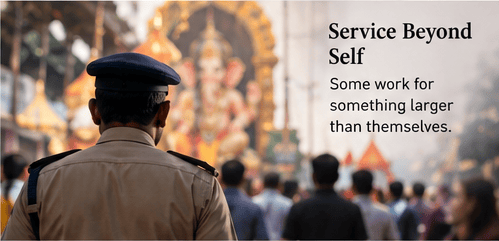
Take police officers.
We may have differences of opinion about public institutions and public servants. We also know that corruption and failures exist within systems. But none of that takes away from the fact that there are sincere police officers who work under difficult conditions, often for modest compensation, while putting their own safety at risk.
Think about festivals such as Ganesh Chaturthi or Dasara.
While many of us celebrate with our families, police officers are often deployed to maintain security and public order, sometimes spending those days away from their own families.
Why do some people continue to do this despite the sacrifices involved?
For some, perhaps, there is a belief in public service—a belief that protecting people, pursuing justice for the victims, is worth something greater than the materialistic rewards of the job.That kind of work can be connected to something larger, a ‘Just Cause’.
Inspiration or desperation?
In Joseph Nguyen’s “Don’t Believe Everything You Think”, there is an idea that stayed with me:
A goal created out of desperation can feel like something we have to pursue.
A goal created out of inspiration can feel like something we want to pursue.
That distinction resonated with me personally. Writing these blogs is one such goal for me. I do a lot of thinking while editing, structuring and putting the content together. But the ideas themselves usually come from something I observe in my life, something I read, a conversation I have, or a question that refuses to leave my mind.
Writing has been a passion for me for as long as I can remember.
Nobody is measuring my performance here.
There is no promotion attached to it.
There is no appraisal rating.
And yet, I continue to do it. Perhaps because the motivation comes from within.
When OKRs meet purpose
In my current assignment at work, I am working with a client on OKRs (Objective Key Results).
The objectives are perfectly legitimate and important: increasing revenue, improving user experience, reducing churn, attracting new customers and so on. These are essential business outcomes.
But as OKRs cascade through an organization and eventually reach individual employees, I sometimes wonder:
Will every employee be able to see the connection between these goals and a larger purpose?
Will they believe they are contributing to a ‘Just Cause’?
Will they set their goals from inspiration—or simply because the organization expects them to?
Don’t get me wrong. OKRs are important. Organizations need measurable objectives. Businesses need revenue. Customers need better experiences. Companies need to survive and grow.But perhaps there is a missing layer between organizational objectives and human motivation.
We are very good at cascading goals.
Perhaps we are not equally good at cascading meaning.
An employee may understand exactly what they need to achieve. But do they understand why it matters? And more importantly, does the goal connect with something their personal ‘Just Cause’?
Saints and scientists: complementary or contradictory?
As I pondered these questions, another thought struck me.
What if our material work and our spiritual journey don’t necessarily have to be separate?
Sanatana Dharma offers multiple paths toward Moksha, and the pursuit of knowledge and disciplined practice has an important place within its philosophical traditions. Indian intellectual history also contains many examples of people who combined philosophical inquiry with subjects like mathematics, astronomy, medicine or other forms of knowledge.
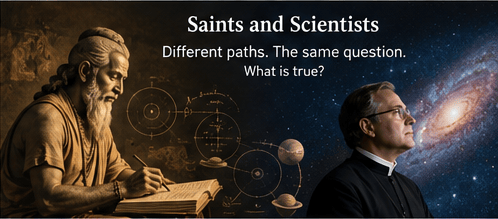
Aryabhata’s work transformed mathematics and astronomy. Rishi Kanada explored questions about matter and its fundamental constituents. And much later, Georges Lemaître—a Belgian astronomer and Catholic priest—proposed the expanding-universe model that became foundational to what is now known as ‘Big Bang’ cosmology.
There is something fascinating looking at these Monk Scientists.
Science asks questions about the external universe. Spiritual inquiry asks questions about consciousness, existence and the self. Perhaps saints and scientists are not necessarily contradictory. Perhaps, in different ways, both begin with the courage to ask:
“What is the truth? Do we have the courage to Pursue the truth.”
Can work become Sadhana?
This is where I find the idea of Sadhana particularly interesting.
We often associate spirituality with meditation, prayer, pilgrimage or withdrawal from worldly life. But what if disciplined practice and the pursuit of knowledge can also happen through the work we do every day?
A scientist can turn curiosity into Sadhana.
A teacher can turn teaching into Sadhana.
A doctor can turn service into Sadhana.
An engineer can turn problem-solving into Sadhana.
A leader can turn developing people and building institutions into Sadhana.
Perhaps the question isn’t whether our profession is inherently spiritual. Perhaps the question is how consciously we engage with it.
And this brings me to the question that started all of this.

Can self-realization happen at work?
Maybe work itself can become a laboratory for self-awareness.
A difficult colleague teaches us about our patience.
A conflict teaches us about our ego.
A promotion teaches us about our relationship with recognition.
Failure teaches us about attachment.
Success teaches us about ambition.
A boring assignment teaches us about discipline.
A challenging assignment teaches us about courage.
A leadership role teaches us how we use power.
And perhaps the most uncomfortable situations teach us the most about ourselves.
And perhaps these should be our measuring metrics instead of Revenue and Growth.
Perhaps the question is not whether we love our work
There is a popular saying: “If you love what you do, you will never work a day in your life.” And we might not love our work everyday and that’s okay. There will be difficult days. Boring assignments. Deadlines. Disagreements. Organizational politics. Failures. But the person we become through all these experiences stays with us and it builds our character.
And perhaps self-realization doesn’t have to wait until we retire, withdraw from the world or reach the final chapters of our lives. Perhaps they were always happening at the same time while we were in the middle of a meeting.
In the way we handle disagreement.
In the way we treat someone who cannot give us anything in return.
In the way we respond to failure.
In the way we pursue knowledge.
In the way we do our work when nobody is watching.
Perhaps the journey from earning a living to finding oneself was never meant to be two separate journeys.
Perhaps they were always happening at the same time.


Leave a comment