The Women Who Raised Me—and the Roles They Inherited
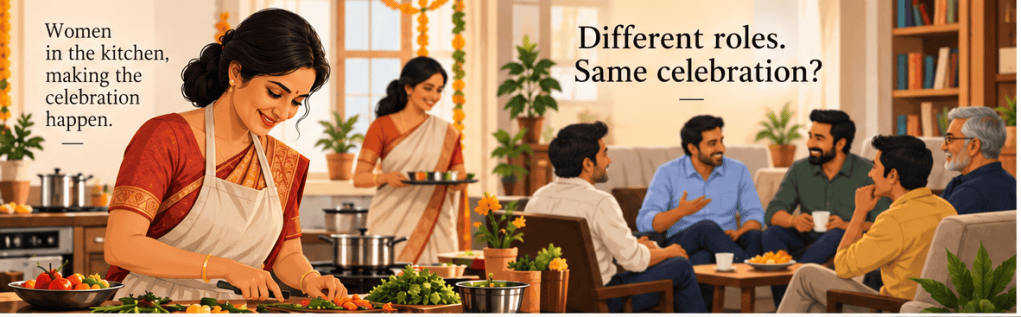
Often, in my household growing up—and even today—I notice something during festivals, family gatherings, and visits from relatives. The hosting almost always falls on the women.
Women are in the kitchen preparing food, arranging the table, serving everyone, making sure guests are comfortable and entertained. Meanwhile, the men sit in the living room discussing politics, cricket, business, finance, and world affairs.
What surprises me even more is that many women themselves accept this as completely normal.
This is what we are supposed to do.
The women who shaped me
I grew up in a joint family, which gave me the privilege of knowing some extraordinary women closely.
Both my grandmothers are at the top of that list.
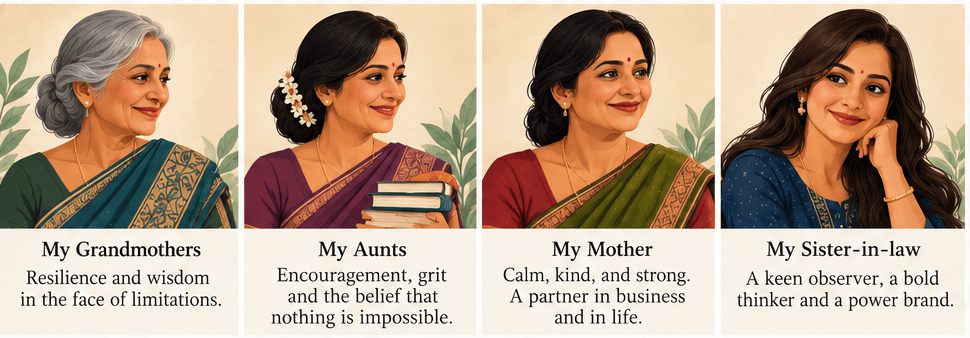
My Bammagaru (paternal grandmother) often told us the story of her marriage. She was five years old and my grandfather was thirteen when they were married, sometime in the early 1940s. She came to her in-laws’ home at the age of twelve, having studied only until the fifth grade. The expectations placed on women in those days were fairly straightforward: once they came of age, they were expected to run the household, cook, care for the family, and eventually raise children.
Yet, my Bammagaru did something remarkable.
Although she had almost no formal financial education, she developed an instinct for managing money. She invested in gold and real estate, took an active role in the family’s financial decisions, and made choices that helped create financial stability for the family. More importantly, she encouraged her daughters and daughters-in-law to study and become graduates.
My Ammama (maternal grandmother) followed a similar path. She devoted herself to her family, supported my mother while raising us, saved money, and eventually bought a house.
These women may not have had access to formal education in finance, management, or leadership.
But they understood responsibility, resourcefulness, and long-term thinking.
Then came my aunts
My Attayalu and Pedammalu (aunts) played an equally important role in shaping me. One encouraged me to read. Two others—and my cousin sister—taught me that nothing is impossible. In many ways, they became my examples for continuing my own education even after marriage. They had shown me that life does not have to end at the boundaries society draws for women.Another aunt carved her own path and built something of her own. I still remember her successfully running tuition centres with 50–60 students at one point.
They never needed a label for what they were doing. They simply lived their lives with courage.
And then, my mother
Of all these women, my biggest inspiration is probably my Amma (mother).
She came from a family where her father was a government employee. After marriage, she had to learn an entirely different way of life. She learned the business alongside my father and continues to run it with him today.
What I admire most about her isn’t just what she achieved.
It is the way she deals with people. She is calm and composed in difficult situations. She has the wisdom to navigate complicated circumstances. She forms genuine bonds with people she meets.
And she is kind.
Sometimes she helps people with money. Sometimes with her time. And often, simply by being there.
The latest addition
And then came the latest addition to our family—my Maradalu (sister-in-law).
I call her a power brand.
She has an incredible ability to observe and analyse situations. She has strong convictions and, more importantly, the courage to stand by them. One thing I particularly admire is her openness—and her ability to handle the constant stream of people my brother brings into their home!
But here is what bothers me
When I look at all these women, I see grit, resilience, strength, intelligence, kindness, entrepreneurship, financial wisdom, and leadership.
And I often wonder:
Did they get enough credit for all of it?
Why is a woman’s contribution so often reduced to cooking, cleaning, caring for the family, and entertaining guests?
Why aren’t those contributions recognised as leadership, management, emotional labour, financial stewardship, and social capital?
And perhaps more importantly, why do we still create situations where women have to choose between being part of the conversation and taking care of everyone else?
Why can’t the men get up and help with hosting?
Why can’t a woman leave the kitchen, sit in the living room, and participate in the conversation about politics, finance, cricket, business, or the world?
And why can’t men do the same things women have traditionally been expected to do?
Perhaps the real problem is the roles themselves
Society may have originally divided responsibilities between men and women based on circumstances, economics, physical demands, or perceived strengths.
But somewhere along the way, roles became rules.
And rules became expectations.
And expectations became traditions.
The problem isn’t that women cook.
The problem isn’t that women care for their families.
The problem isn’t even that some women genuinely enjoy doing these things.
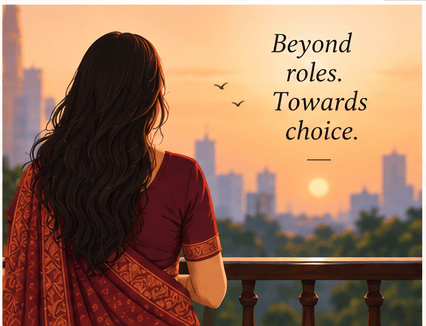
The problem is when choice disappears.
A woman should be able to cook because she wants to—not because she is expected to.
A man should be able to host guests, cook a meal, serve food, or take care of children—not because he is “helping” his wife, but because it is his family too.
Perhaps equality isn’t about making men and women identical.
Perhaps it is simply about giving both the freedom to choose which roles they want to play.
The women in my family taught me resilience, courage, intelligence, kindness and the ability to build something from very little.
I hope the next generation of women—and men—gets the freedom to use all of those qualities outside the boundaries of the roles society has traditionally assigned to them.
Because a festival should be a celebration for everyone.
Not a celebration where some people sit in the living room while others spend the entire day making it possible.


Leave a Reply