The word feminism often invokes mixed reactions. For some, it represents women’s empowerment and equality. For others, it is associated with preferential treatment or an attempt to create an imbalance in the name of equality. Perhaps the problem begins with what we think feminism means.
At its core, feminism is the belief in social, political and economic equality of the sexes. A feminist is anyone who believes in and advocates for that equality.
If that is the definition, then why shouldn’t feminism have a place in organizations?
I believe it should.
But perhaps we need to look beyond the conventional ways we discuss it.
A Wednesday Afternoon and a Lesson in Feminism
It was a regular Wednesday afternoon. I was chatting with one of my European clients. I was one of the coaches assigned to their teams, while two of my male colleagues were working with other teams under the same client. The three of us were part of a group chat.
As the conversation progressed, I noticed that the client seemed to lean more towards my male colleagues for answers. He also appeared more comfortable with them, making jokes and engaging more casually.
My immediate reaction?”He is being chauvinistic.”
And the feminist in me — as my husband often points out after almost every argument between us 😇 — was ready to judge him.
But then I paused.I noticed that the client was much more jovial with one of my male colleagues than with the other as well.That changed my interpretation.
Perhaps this wasn’t about gender at all.Perhaps it was simply about personal chemistry, familiarity, communication style and comfort.
That realization made me think differently about feminism.
Equal vs. Fair
Equality and fairness are often used interchangeably, but they aren’t necessarily the same.
Fairness may require removing barriers rather than simply giving everyone the same resources. But fairness also does not mean lowering the bar. Women should have the same access to opportunities, mentorship, challenging assignments, promotions and decision-making forums.Once given that opportunity, however, the same standards of competence, accountability and performance should apply.It should not be:
Give me this because I am a woman.
It should be:
“Don’t prevent me from pursuing this because I am a woman.”
That, to me, is where organizational feminism should begin.
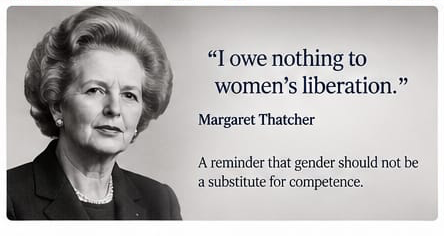
Margaret Thatcher, the longest-serving British Prime Minister of the 20th century, famously represented a very different view of feminism. She often emphasized individual achievement and merit rather than seeing herself primarily through the lens of women’s liberation.
The Monkey and the Fish
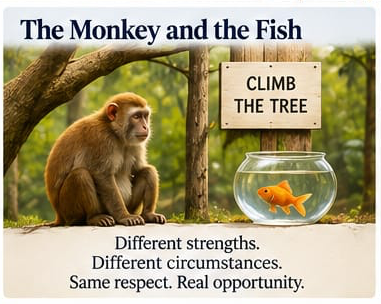
There is a popular analogy of different animals being asked to climb a tree. The monkey is naturally equipped for it; the fish isn’t.
If both are judged solely on their ability to climb, the fish will inevitably be labelled a failure.
Organizations can make the same mistake when they define success through a single model and expect everyone to fit it.
Fairness doesn’t mean pretending everyone has identical circumstances. It means ensuring that circumstances do not become unnecessary barriers to opportunity.
Give Women the Right to Fail
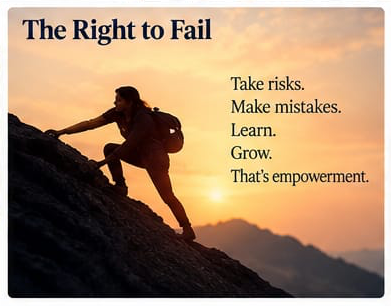
One issue I have observed in organizations is that we sometimes unintentionally give women less room to fail.
When a man’s failure is treated as an individual’s failure, while a woman’s failure is subconsciously interpreted as evidence that “women aren’t good at this,” the consequences are very different. Women may become more cautious about taking risks.
But leadership requires risk.
Innovation requires risk.
Career growth requires risk.
True empowerment means creating an environment where women can take ambitious assignments, make decisions, make mistakes, learn and try again.
Empowerment isn’t protecting women from failure. It is creating enough psychological safety for them to fail without their failure becoming a referendum on their gender.
Feminism Is More Than Clothes
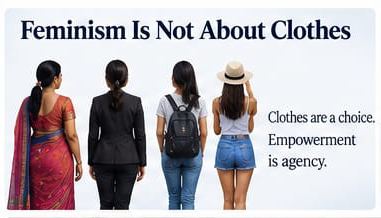
Another area where feminism often gets unnecessarily reduced is women’s appearance.
What a woman chooses to wear is her choice.A woman wearing traditional clothing is not necessarily less empowered.
A woman wearing western clothing is not necessarily more empowered.
A woman’s clothing is a choice. It doesn’t determine her empowerment.
Representation Is Important — But Representation Alone Isn’t Enough
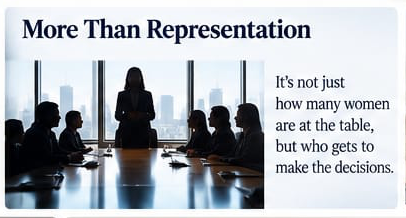
Similarly, having more women in leadership is important, but representation alone doesn’t tell us who actually has influence.
We should ask:
Who makes the decisions?
Who controls budgets?
Who influences strategy?
Who gets the difficult assignments?Who is allowed to fail?
And perhaps one of the most important questions:
Who gets to make financial decisions?
Financial independence and participation in financial decision-making represent much more than a title. They represent power, autonomy and trust.
Career Breaks Shouldn’t Become Career Penalties

Women sometimes take career breaks to prioritize family responsibilities. A career break should not automatically be interpreted as a loss of ambition or capability.
Caregiving is work. Raising children is responsibility.This doesn’t mean women should receive promotions simply because they are mothers. It means a career break should not permanently disqualify someone from opportunities for which she is otherwise capable.
Organizations should create pathways for people to return, rebuild skills and continue their careers.
Feminism and Merit Are Not Opposites
I strongly believe women should have equal opportunities. But I don’t believe women should receive promotions, positions or concessions simply because they are women. Gender should not be a barrier to opportunity. But gender should not be a substitute for competence either.
We don’t necessarily empower women by constantly reminding them that they are women. Sometimes we empower them by allowing them to simply be professionals, leaders, decision-makers and human beings — judged by the same standards as everyone else.
So, Should Feminism Apply to Organizations?
Absolutely.
But perhaps we need to measure it differently.
Instead of simply asking:
– How many women are in leadership?
– How many women are hired?
We should ask:
– Do women have equal access to opportunities?
– Are they encouraged to take risks?
– Do they have meaningful decision-making authority?
– Can they fail without their failure being attributed to their gender?
– Are career breaks treated fairly?
– Do they participate in financial and strategic decisions?
– Are performance standards consistent across genders?
We cannot — and perhaps should not — guarantee identical outcomes. But we should work towards ensuring that gender does not predetermine those outcomes.
Feminism Should Create Freedom, Not Dependence

The ultimate goal of feminism, in my view, should not be to create a world where women need organizational protection. It should create a world where women don’t need protection from being women. A woman should be able to compete, lead, negotiate, make financial decisions, take risks, fail and succeed without her gender becoming either a disadvantage or an automatic advantage.
Perhaps the most meaningful form of empowerment is when a woman’s gender becomes almost irrelevant to the conversation — not because gender differences don’t exist, but because competence, character, judgement and contribution matter more.
And perhaps that is where feminism in organizations should ultimately take us:
Not towards a world where women are given more because they are women, but towards a world where they are never given less because they are.


Leave a Reply