Imagine you started building a beautiful two-storey house for yourself.
You laid a strong foundation, erected the pillars, constructed the rooms, plastered the walls, painted everything, furnished the house, and even designed a beautiful garden in front of it.
You finally invite your spouse over for the grand reveal.
They walk in, look around and ask:
“So… where’s the kitchen?”
You proudly respond:
“Well… we haven’t decided yet. But look at the beautiful furniture!”
That probably wouldn’t be the start of a very peaceful evening.

Yet, this is surprisingly close to what happens in many organizations when they try to implement Product teams and Agile methodologies.
Agile is not a magic paintbrush
Just as you wouldn’t build every room in your house to exactly the same specifications and then decide later whether it’s a kitchen, bedroom, bathroom, or living room, you shouldn’t create teams with identical structures and responsibilities and simply label them “Product teams.”
A kitchen has a purpose. A bedroom has a purpose. A bathroom has a very specific purpose—and trust me, you don’t want the architect saying, “We kept it flexible. You can figure out its purpose later.”
The same principle applies to teams.
Every Product team needs a clear purpose, a defined customer, a product or problem space to own, decision-making boundaries, and accountability for outcomes.
Only then does it make sense to design the team with the right capabilities, roles, skills, and ways of working.
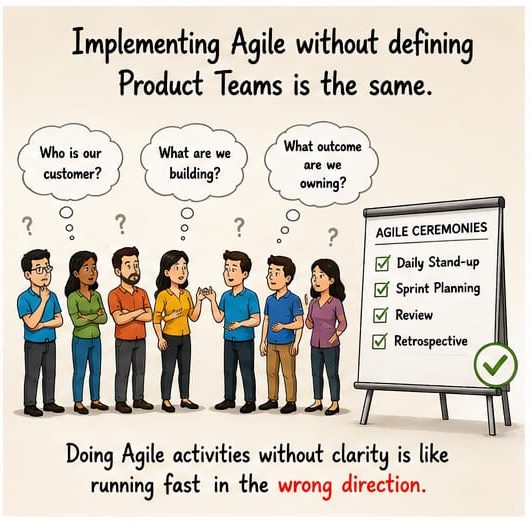
So, why are organizations in such a hurry? Why do companies rush to implement Product teams and move towards Agile-led delivery models?
The answer is both simple and complex.
Often, the organization knows where it wants to go, but hasn’t spent enough time defining how the organization should be structured to get there.
Strategy sits at the top, but information cannot remain there.
It has to flow downward—from strategy to leaders, from leaders to products, and from products to teams.
And then the more important part: information needs to flow back up.
Customer feedback, market signals, delivery challenges, product insights, experiments, failures, and successes need to continuously influence the strategy.
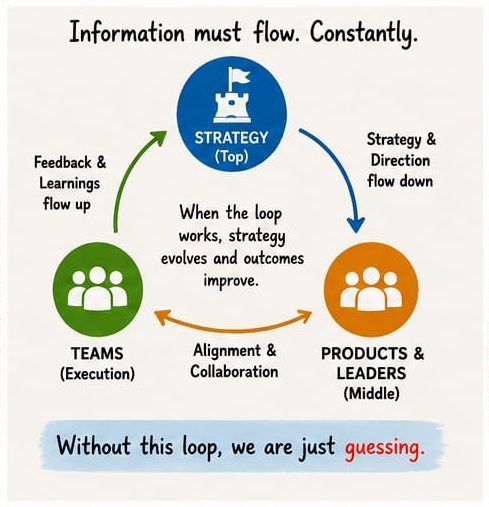
Otherwise, we end up with a rather interesting organizational version of the telephone game:
Leadership says one thing → middle management interprets it → teams translate it → Jira records it → dashboards celebrate it → customers wonder what just happened.
Don’t ask the soldiers to fire without showing them the target
Asking teams to “become Product teams” without actually defining the products they own is like asking soldiers in the trenches to fire at the enemy without checking whether there is an enemy on the other side.
There may be a lot of firing.
There may be impressive firing-rate metrics.
There may even be a dashboard showing “100% ammunition utilization.”
But none of that tells us whether we hit the right target.
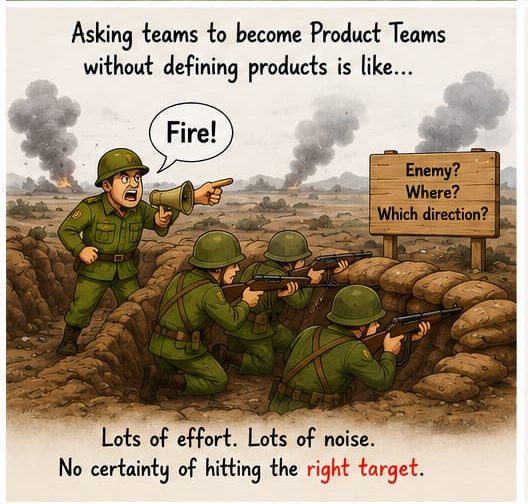
Similarly, measuring velocity, story points, sprint completion, number of releases, or features delivered can tell us how much work was done.
It doesn’t necessarily tell us whether we solved the right customer problem.
Product teams need purpose before process
A Product team isn’t simply a group of people attending stand-ups, planning sprints, updating Jira, and moving cards from To Do to Done with impressive enthusiasm.
A true Product team has:
- A clear mission
- A defined customer or user
- A product or problem space to own
- The autonomy to make meaningful decisions
- The right cross-functional capabilities
- Clear outcome accountability
Once these foundations are in place, practices such as PDLC, Scrum, SAFe, OKRs, continuous discovery, experimentation, and outcome-based measurement can actually create value.
Otherwise, organizations risk creating something far less exciting:
Very efficient teams delivering the wrong things.
Which, to put it politely, is like having a Formula 1 car with an excellent pit crew… driving confidently in the wrong direction.
Agile should be the enabler, not the destination
No matter how sophisticated the tools are, how experienced the coaches are, or how impressive the Product operating model looks on a PowerPoint slide, an organization will struggle to keep up with change if continuous planning, execution, learning, and feedback loops aren’t working together.
The transformation shouldn’t begin with:
“Which Agile methodology should we implement?”
It should begin with:
“What products do we have?”
“Who are our customers?”
“What problems are we solving?”
“What outcomes are we accountable for?”
And finally:
“How should we organize our teams so they can actually own those outcomes?”
Once the foundation is right, Agile becomes an enabler rather than the destination.
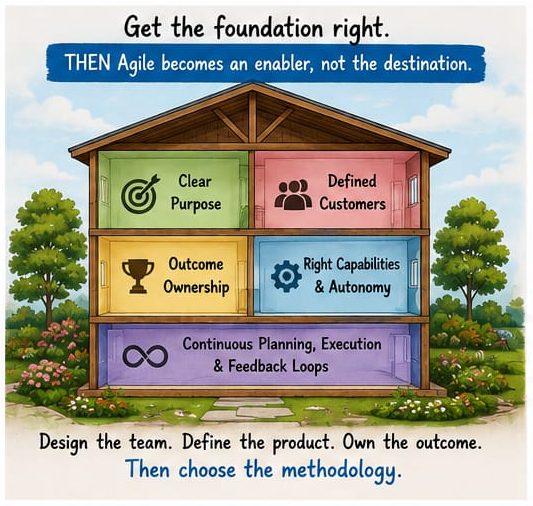
Because at the end of the day, you don’t build a house by buying the best paint and then deciding what the rooms should be.
You decide what the rooms are first. Then you build them for their purpose.
The same is true for Product organizations.
Define the product. Design the team. Establish the ownership. Then choose the methodology.
Otherwise, we may end up with a beautifully painted house where everyone is standing in the hallway asking:
“Okay… but where’s the kitchen?”


Leave a Reply