Where does a mother’s responsibility end—and her child’s journey begin?
I am a mother.
And sometimes, that terrifies me.
Day and night, I wonder: Am I raising a happy child? Am I doing everything right? Or am I unknowingly doing something wrong?
Sometimes the thought is even more frightening: What if I fail so badly that I raise someone capable of hurting others?
It scares me to send my child out into the world, especially when I look at everything happening around us. But I also know that I cannot protect him forever. At some point, I have to let him walk into the world on his own.
Traditionally, in every society, mothers have played an enormous role in raising children. That is not to undermine fathers in any way. My husband, in fact, is an exceptional father. He is deeply involved in our son’s life, and the two of them often behave more like friends than a father and son.
But there is something about motherhood that makes me constantly question myself.
I look at the world around me and I look at Gen Z—their strengths, their struggles, their ideas on freedom, responsibilities, their vulnerabilities.
I see incidents like the one at IIT Bombay. I am not interested in discussing the politics surrounding it. What pains me is something much more fundamental: How did we reach a point where a young person sees failure as the end of life?
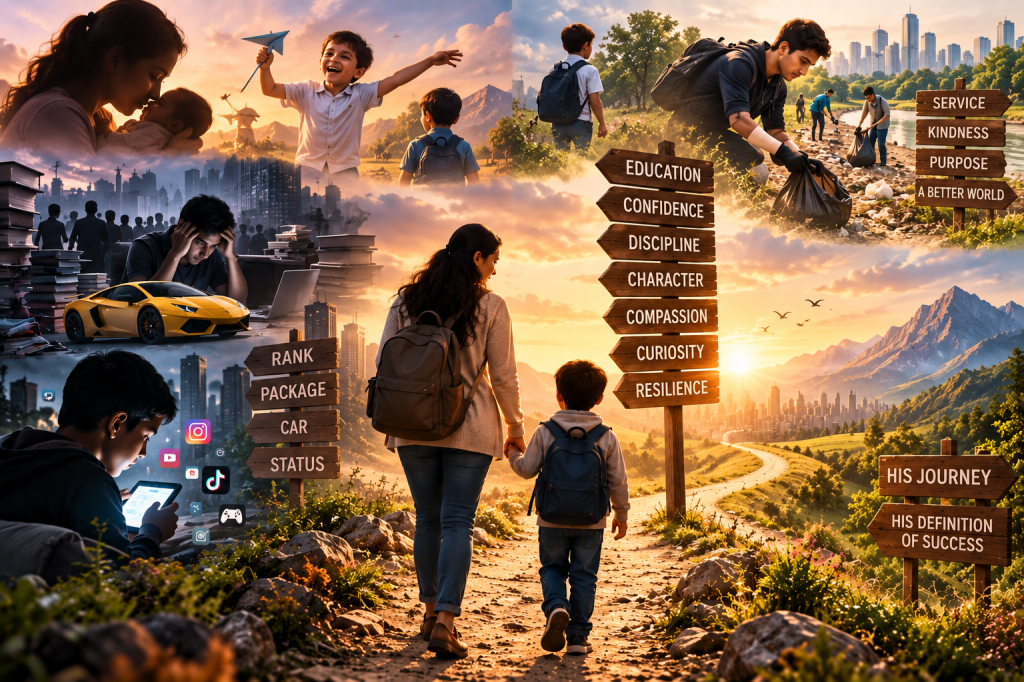
What happened along the way? Did we show our children the wrong examples? Did we unintentionally teach them that success means graduating from a prestigious college, getting a ₹1 crore package, buying a beautiful house and living a financially comfortable life?
How do we measure success? And more importantly, what is that measurement doing to our children?
Then there is societal pressure. I often hear our relatives say, “We raised three to four children. Our parents raised even more. And everyone turned out fine.”
Perhaps they did.
But the world they raised children in is not the same world we are raising our children in. Our children have the entire world’s information available at their fingertips. Our children are constantly exposed to curated images of other people’s lives, wealth, bodies, achievements and lifestyles.
The threats parents face today are different. It is no longer just about protecting a child from a stranger in a park.
It is about understanding what is entering their minds through a screen when we are not watching.
Children today are also more independent, more informed and, in many ways, more decisive. The first time I ever sat in a car is in my late teens. Today, my son tells me that his favourite car is a Lamborghini. I am not criticizing or condescending here. There is absolutely nothing wrong with wanting beautiful things, dreaming big or aspiring for wealth.
But sometimes I wonder:
Does he understand the difference between wanting a Lamborghini and believing that owning one is the definition of success?
And then I see young people like Bittu Tabahi, who at just 20 years of age are working to clean rivers and public spaces and contributing to their communities.
And I wonder—
Should that be our measure of success?
The number of people we help? The lives we touch? Or simply the ability to live a life that has meaning to us?
And then comes the question that makes me wonder:
What path will my Gen Alpha son choose?
And how much of that path will reflect on me as his mother? Am I responsible for his successes? His failures? Both?
The more I think about it, the more I realize something I had not seen before.
Perhaps I have been looking at my child’s success and failure from my own perspective.
I have been defining what success should look like for him. And suddenly, I understand what has been terrifying me all along.
I am trying to control an outcome that was never mine to control.
As parents, we have responsibilities to guide our children. Nurture them. Protect them when they are vulnerable. Teach them right from wrong. Give them education. Teach them discipline. Show them resilience. Help them build character.
But we cannot decide their destination.
We have no right to define success for them.
Every human being should have the freedom to decide what success and failure mean in their own life.
I remember a dialogue from the movie Asoka. Shah Rukh Khan’s character asks a Buddhist monk:
“Who can be greater than a Samrat—the king of kings?”
The monk replies, in essence:
“A traveller who completes his journey.”
That thought stays with me. Who am I to define my son’s journey? Who am I to decide which road he should take, which mountains he should climb or what destination should make his life meaningful?
My job is not to write his story. My job is to make sure he has the tools to write it himself. And the courage to keep walking even when the road becomes difficult.
We decided to bring our children into this world. It is our karthavya to give them the best tools we can. To support them. To guide them. To be there when they fall. But we have no right to choose their path and decide their destiny.
Perhaps motherhood becomes a little less frightening when I understand that. The day I stop measuring my success as a mother by the heights my son reaches is the day I truly become successful as a mother.
And perhaps, instead of constantly asking,
“Am I raising my child right?”
I should ask myself:
“Am I raising a child who is capable of defining success for himself—and brave enough to pursue it?”
Because ultimately, his journey is his.
And my journey as a mother is simply to walk beside him for as long as he needs me.


Leave a Reply