Why do population policies keep talking about children while forgetting the women who have to bring them into the world?
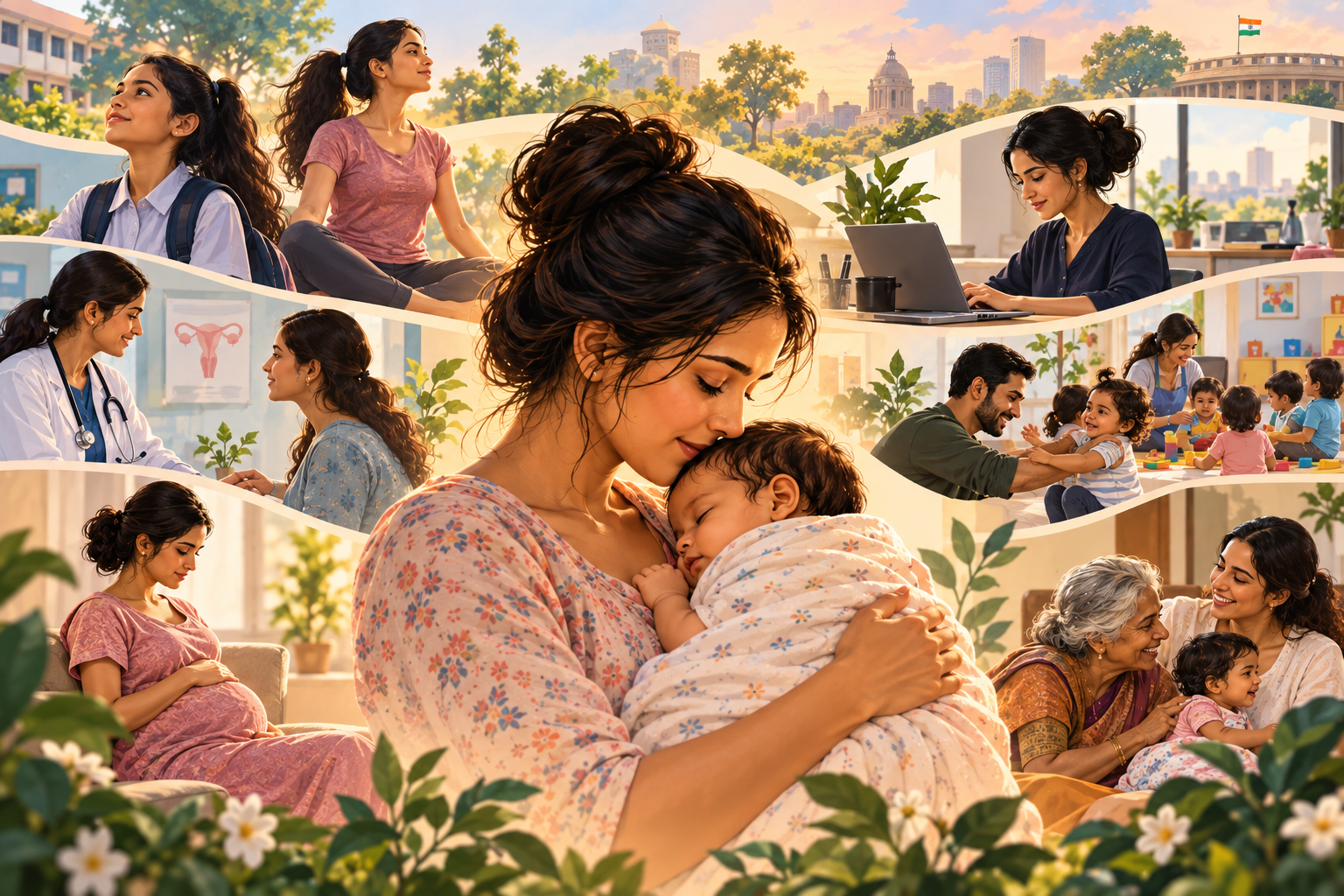
Recently, India’s declining fertility rate has been receiving increasing attention. With fertility falling below the replacement level in many parts of the country, governments are beginning to think about how to encourage people to have more children.
And some of the responses are already emerging.
The Andhra Pradesh government has announced incentives for families having a third child, including a financial benefit and support for the child’s education.
Tamil Nadu has also been discussing measures aimed at making parenthood easier, including extending maternity leave.
But somewhere in all these conversations, we seem to have forgotten the most important character in the story
The woman.
It is a woman’s body that goes through pregnancy.
It is her body that undergoes enormous physiological changes.
It is her body that experiences childbirth and recovery.
And, in most families, it is still disproportionately her time, career and emotional energy that are consumed by childcare.
So when governments ask, “How do we encourage people to have more children?”, perhaps the first question should be:
“What would make women feel supported enough to want another child?”
Because a cash incentive may make childbirth financially attractive on paper. But childbirth isn’t a transaction.
We cannot solve a demographic problem by creating a workplace problem
Women already encounter significant barriers in the workplace. A policy that extends maternity leave without simultaneously addressing childcare, workplace flexibility and gender discrimination could have an unintended consequence: employers may become even more hesitant to hire or promote women of childbearing age.
The objective may be to support motherhood. But if the structure surrounding the policy is poorly designed, the women may end up paying for that support through their career. The solution therefore cannot simply be more maternity leave. There has to be better support around motherhood.
What women actually need is a support system
A woman shouldn’t have to choose between being a good mother and being a successful professional.
She needs affordable, accessible and safe childcare.
She needs parents, in-laws and extended families who help without making her feel guilty for asking for help.
She needs workplaces that don’t treat motherhood as a liability.
She needs fathers who are expected to participate in parenting—not merely praised when they do.
She needs daycare facilities with strong safety standards and meaningful regulatory oversight.
And she needs financial support that actually strengthens her economic agency.
Simply putting money into a household does not automatically mean that the woman who bears the physical and emotional cost of pregnancy controls that money.
If governments genuinely want to make parenthood easier, they should think beyond a one-time incentive and invest in the ecosystem around the child.
We often celebrate the baby and forget the mother
There is another conversation that is often missing: women’s health after childbirth.
Pregnancy doesn’t end when the baby is born. Yet our attention often shifts almost completely toward the newborn and his/her well being. Meanwhile, the mother is expected to recover quietly.
We rarely ask:
Is she eating properly?
Is she sleeping enough?
Has she regained her strength?
Is she exercising?
How is her mental health?
And, perhaps most importantly:
Does she have any time left to look after herself?
Women’s health cannot be an afterthought
This is where the conversation around fertility becomes even more interesting. The Andhra Pradesh government is also proposing IVF fertility treatments for couples through government hospitals.
But why should our response to declining fertility focus primarily on fertility itself? Why not also ask what is happening to women’s reproductive health much earlier in the journey? Why treat the symptom when we can also address some of the underlying problems?
PMOS, for example, is one of the common reproductive and metabolic health conditions affecting women today. It can affect menstrual cycles, ovulation and fertility, while also being associated with metabolic conditions such as insulin resistance, obesity and diabetes.
Reproductive health cannot be separated from overall women’s health. We should therefore be investing more in early identification, awareness, prevention and long-term management. Perhaps this conversation should begin much earlier.
We should encourage school-going teenage girls to participate in sports, yoga and other physical activities, while also helping young women and their families understand the importance of balanced nutrition, healthy lifestyles and regular healthcare.
This isn’t about asking girls to conform to a particular body type. It is about helping them understand their bodies and giving them the tools to take care of their health. Reproductive healthcare should be about more than helping a woman become pregnant.
Reproductive healthcare should be about helping woman remain healthy well throughout her reproductive years and beyond.
Pregnancy doesn’t end when the baby is born
Pregnancy and the postpartum period can bring significant changes in weight, metabolism, hormones and mental health. Yet culturally, we often believe a mother “getting back to normal” without giving her the resources, time or support required to actually recover.
We tell new mothers to take care of the baby, that motherhood requires sacrifice. But do we encourage her to try to eat better, exercise, rest or simply spend an hour taking care of herself?
Perhaps this is the cultural shift we need to make.
If we want women to have children, we need to create a society where motherhood does not require women to disappear into it.
Because the question is not simply:
“How many children should a woman have?”
The more important question is:
“What kind of society are we creating for the woman who has them?”
Because the womb may create life, but it takes an entire ecosystem to support women in raising the children they bring into the world.


Leave a Reply