Telugu Cinema — Where I First Met History, Discovered Heritage, Studied Literature and Began to Understand Life.
I have always loved Indian history—not merely the version I encountered in school textbooks in the 2000s, where the Delhi Sultanate and the Mughals seemed to occupy disproportionate space, often detached from the enormous and complicated civilisations that existed across the rest of the subcontinent.
I wanted to know the India that existed before, alongside, and beyond them.
The Chalukyas. The Rashtrakutas. The Ahoms. The Cholas. The Kadambas. The Mauryas. The Cheras. The Pandyas. The Karkotas. And, among all these magnificent dynasties, the one that fascinated me most—the Tuluvas.
I have a particular admiration for Sri Krishnadevaraya of the Tuluva dynasty.
I still remember the first time I learned about the brutal end of Rama Raya and the Battle of Talikota. The image of his severed head being displayed by the Deccan Sultanates disturbed me so deeply that I could not sleep that night.
That is what history can do when it stops being a list of dates and names.
It can make you feel.
My first history teacher – my father
My love for Indian history and heritage began when I was around ten years old. And I had two extraordinary teachers, though neither of them stood in a classroom.
The first was my father.
He encouraged me to read from a very young age. But reading was only one part of what he gave me. He was—and still is—a fantastic orator, with a captivating voice and an ability to command the attention of an entire room.
He would narrate stories from the Ramayana and the Mahabharata, stories of rishis and philosophers, and the lives of people such as Swami Vivekananda and Ramakrishna Paramahamsa. He told us about freedom fighters and leaders such as Sardar Vallabhbhai Patel and Alluri Sitarama Raju.
And he didn’t simply tell us these stories. He made them come alive.
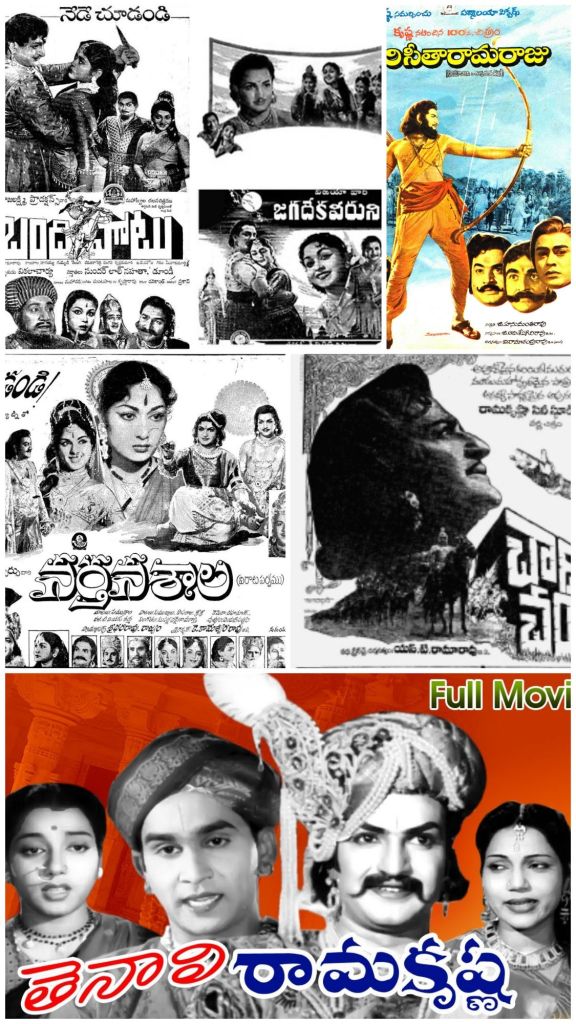
And my love for old Telugu cinema came from him too. I still remember watching movies such as *Jagadeka Veeruni Katha* and *Bandipotu* with him.
But the movie that changed something in me was *Tenali Ramakrishna*.
The first time I watched it with my father, I was introduced to the grandeur of the Vijayanagara Empire—not through a chapter in a textbook, but through characters, costumes, palaces, poetry, humour, conflict and ambition.
NTR as Sri Krishnadevaraya; ANR as Tenali Ramakrishna and Nagayya as Appaji.
I was fascinated.
The Vijayanagara Empire suddenly wasn’t something from a distant past.
It had faces.
It had personalities.
It had politics, friendships, rivalries, humour, ambition and tragedy.
And somewhere between watching that film and asking my father questions about the characters, I started picking up books on Indian history.
Telugu cinema has always been special
Telugu cinema has repeatedly returned to India’s history, mythology, folklore and cultural traditions.
Think of films such as *Chandragupta*, *Mahamantri Timmarusu*, *Alluri Seetarama Raju*, *Bobbili Yuddham*, *Rudramadevi*, *Sye Raa Narasimha Reddy*, *Gautamiputra Satakarni*, *Pothuluri Veerabrahmendra Swami* and, more recently, the global phenomenon *RRR*.
Not all of these films are historically accurate. Some take enormous creative liberties.Some are based on legends. Some blend history with fiction. However, there is something important about the fact that these stories were told at all.
They put Indian kings, warriors, poets, rebels, philosophers and freedom fighters back into popular imagination.
They gave historical figures faces.
They gave forgotten stories an audience.
They made children curious. And curiosity is often where the study of history begins.
This is why I think Telugu cinema deserves to be looked at not merely as entertainment, but also as a keeper of cultural memory.
Telugu cinema has always been a reflection of Indian heritage and culture and is unapologetic in showcasing India’s history, and civilisational richness. They also did not hesitate to portray foreign invasions—including those of the Mughals, Bahmanis, and the British. They did not romanticise these invasions or soften the reality of what happened and how it happened.
For me, that is one of the most remarkable things about Telugu cinema. It did not always try to make history comfortable. It told stories of kings, warriors, resistance, ambition, betrayal, courage, and loss—and, in doing so, kept many aspects of India’s historical and cultural memory alive in popular imagination.
When mythology became part of everyday life
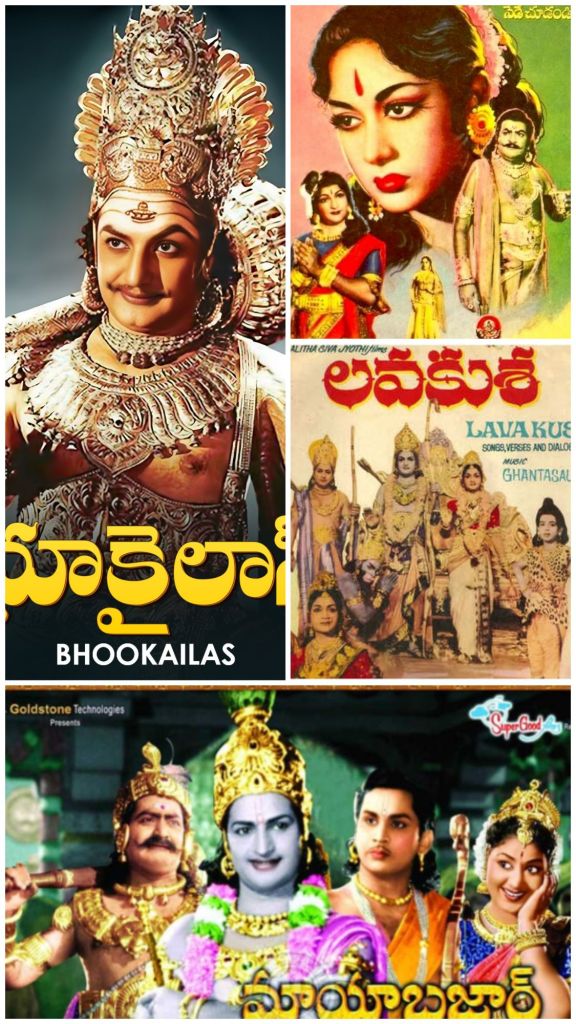
The same is true of Telugu *Pauranika* and *Janapada* cinema. For generations, films based on the Ramayana, Mahabharata and Puranic traditions were not simply movies. They became part of household culture.
*Lava Kusa.* *Mayabazar.* *Nartanasala.* *Sri Krishna Pandaveeyam.* *Bhukailas.* *Sitarama Kalyanam.*
These films didn’t always present characters as simple heroes and villains. That is one of the things I found fascinating.
Take Ravana in *Sitarama Kalyanam*. He was not merely presented as a one-dimensional villain. He was magnificent, powerful, learned, proud and deeply flawed. Because mythology, at its best, doesn’t simply tell us **who is good and who is evil**.
It asks us why people become who they become.
Others made me think about the complexities of life, the contradictions within human nature, the choices we make, and even how we choose the people we call our friends.
Looking back, I realise how deeply my father have shaped me. He intorduced me to right movies, gave me a love for reading, and that inturn gave me curiosity to understand people beyond what appears on the surface, and an instinct to question, reflect, and look for meaning in the stories around me. Most importantly, gave me the confidence to put my own thoughts and ideas into words.
In many ways, the person I am today was shaped by those evenings spent listening to my father, watching old Telugu films, getting lost in stories of kings and warriors, and eventually picking up books to find out what was real and what was fiction.
What began as a child’s fascination with stories slowly became a lifelong love for history, human nature, and the written word.
My father gave me the stories.
Telugu cinema gave those stories a face.
Books gave me context.
And history gave me understanding and ability to question.
That combination shaped the way I look at the world even today.
So I love Telugu cinema, not the songs, the actors, the comedy or the nostalgia.
I love it because, for someone like me, it was one of the first places where India felt enormous.
An India of kings and poets.
Of temples and battles.
Of empires and invasions.
Of mythology and folklore.
Of courage, betrayal, devotion, ambition and greatness.
An India that existed long before I opened a history textbook.


Leave a Reply