When feminism loses its core identity and principles, it can become detached from the very idea it was created to advance. At its heart, feminism is a pursuit of equality, dignity, agency and fairness. But these universal principles do not exist in isolation from the society in which they are applied. India is a civilisation with its own history, family structures, traditions, philosophical ideas, and understanding of dharma and karma. So perhaps the question we need to ask is: How do we pursue the universal principles of equality and fairness while understanding our society in which we are trying to apply them?
I am a feminist.
I have firm convictions, and I have the courage to stand by them. I am a rule-breaker, a decision-maker, and sometimes one who starts traditions of her own. I dress the way I feel confident and comfortable. I have no hesitation in saying ‘no’ when I don’t want to do something.
But I am also a caregiver. I put my family’s needs before mine when circumstances demand it. I sacrifice when I believe someone I love needs me to. I take my roles as a mother, wife, sister, daughter and daughter-in-law seriously. I may not always get everything right, but I try to do justice to each of these relationships.
And I don’t see these two sides of me as contradictory; I see them as complementary.
Because I don’t believe feminism means choosing between freedom and responsibility. I believe it means having the freedom to choose—and having the courage to take responsibility for those choices.
Today, when I look around, I see women and men speaking loudly about feminism. And that’s important. But sometimes, in our enthusiasm to champion an idea, we seem to lose sight of what the idea actually stands for.
For me, feminism begins with equality and fairness. And perhaps it should go even further: equality of human beings irrespective of sex, race, colour, caste, sexual orientation or social background. Equality does not mean that women are always right. It certainly does not mean that we should blindly support someone simply because they belong to our gender.
There are laws created to protect women and children because genuine injustice exists. Domestic violence is real. Sexual violence is real. Child sexual abuse is real. Rape is real. These are not abstract social debates; they are devastating realities that continue to affect people.
As a woman, I stand firmly with survivors and with their right to seek justice. But protecting the vulnerable also requires protecting the principle of justice itself. When laws created to protect people are deliberately misused, the answer cannot be silence simply because raising the question might be labelled “anti-feminist.” Justice cannot depend on gender.
Perhaps this is where I struggle with some versions of contemporary feminism.
Feminism means having the freedom to wear what you choose—not using your freedom as an excuse to deliberately disrespect another person’s faith or dignity.
Feminism means having the freedom to express your opinion—not believing that everyone who disagrees with you is oppressive.
Feminism means making your own decisions—not denying other people the right to make theirs.
Feminism means having agency over your own body and the right to decide whom you share intimacy with—not using that freedom to shame people whose choices are different from yours.
Feminism is not about flaunting smoking, drinking alcohol or having unrestrained sexual relationships as symbols of liberation. Those may be individual choices available to adults, subject to consent, law and personal responsibility.
The essence of feminism, to me, is
The courage to say: This is my life; These are my choices; And I will take responsibility for them.
And perhaps equally importantly: Your life is yours; Your choices are yours; And I will not demand that you live by mine.
Looking at feminism through an Indian lens
Perhaps one of the problems is that we sometimes approach feminism entirely through frameworks developed in Western societies with very different histories, traditions, and social structures.
Every society is rooted in its own traditions, culture, and dharma. We Indians believe in karma. We are in the land of Karma Bhoomi, and we believe that our actions have repercussions, both in this life and beyond.
And what does that have to do with feminism?
I believe our Vedas and Puranas have, at their core, recognised the spiritual worth of both men and women. I acknowledge the fact that men are permitted to study the Vedas but not women; yes, that is true, but I believe it is not because our Vedas and Puranas consider women inherently inferior.
In Sanatana Dharma, moksha is attained through multiple paths. In the case of women, they bear children, raise them, run the household, and often are the ones who bind and hold the social fabric of our society together. Hence, our dharma said that it is not necessary for women to study the Vedas to attain moksha; if they perform their karma without apeksha, they attain moksha. Hence the saying that the wife receives half of the punya from her husband’s karma.
In that understanding, a woman’s spiritual worth does not depend on whether she performs exactly the same duties as a man. The path may be different, but difference in responsibility does not have to mean difference in spiritual value.
So what went wrong?
I think somewhere along the way, we started imparting greater value to the man who brings financial stability to the house over the woman who holds the household together, and that is where the friction started. And perhaps that is where we began to lose something important.
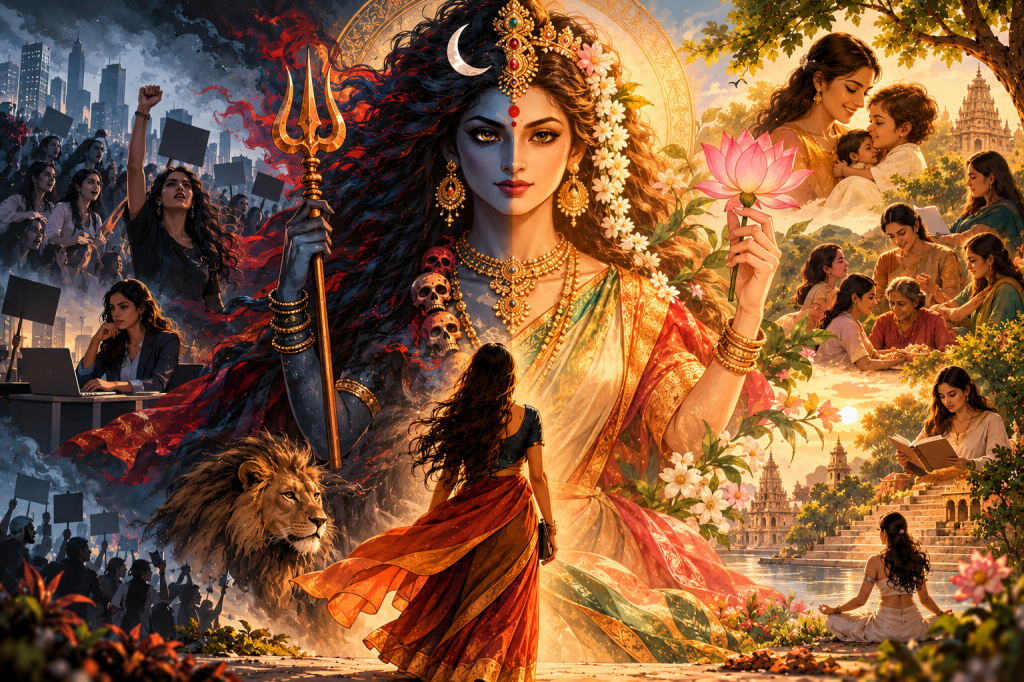
Somewhere along the way, we started seeing only Maa Parvati and forgetting Maa Kali.
We celebrated the woman who nurtures, sacrifices, adjusts and sustains the family, but became uncomfortable with the woman who questions, refuses, challenges and fights.
Yet both are forms of Shakti. Both belong to the same consciousness. And we pray to both.
The feminism I believe in
I do not believe in the feminism that abandons responsibility; that romanticizes every act of rebellion as liberation; that demands unquestioned loyalty to women simply because they are women; or that asks women to abandon their traditions and culture in pursuit of a misguided idea of the “modern woman.”
But I believe in feminism that owns freedom with boundaries, rights with responsibilities, and equality with fairness.
A feminism that understands that strength and compassion can coexist; that allows a woman to be both Maa Kali and Maa Parvati—fierce when she must be, nurturing when she chooses to be, and never forced to choose between the two.
Because the quest for feminism should not lead us towards anarchy.
It should lead us towards a society built on Dharma—a society that recognises individual freedom while remaining conscious of responsibility, justice, dignity and the greater good.


Leave a Reply